How to Choose Cognac
At first glance a shelf of cognac can seem complicated: letters on the label, French place names and a very wide range of prices. In fact, a few principles are enough to find the bottle that suits your taste, the occasion and your budget. Here is a short guide on where to begin.
Start with the age category
A cognac’s age category shows how long the youngest eau-de-vie in the blend has aged. The blend may in fact also contain much older eaux-de-vie, but the category gives a good first direction.
- VS — at least 2 years. Fresh and fruity, good for cocktails and long drinks.
- VSOP — at least 4 years. Smoother and rounder, good both neat and in a cocktail.
- Napoléon — at least 6 years. Mature and warm, between VSOP and XO.
- XO — at least 10 years. Deep and many-layered, for slow enjoyment.
- Extra and Hors d’Age — officially the XO category, but usually a house’s oldest blends.
- Millésime — a cognac made from the harvest of a single year.
The older the cognac, the more notes of oak, dried fruit and spice it has. A younger cognac, on the other hand, is livelier and fresher — not worse, simply different.
Origin: six growing areas
The Cognac region is divided into six growing areas, or crus. The most prized are Grande Champagne and Petite Champagne, whose chalk soils give refined, long-lived eaux-de-vie. Borderies gives round, floral cognacs, Fins Bois and Bons Bois fruity, faster-maturing ones, and Bois Ordinaires by the ocean gives eaux-de-vie with a maritime character.
If the label says Fine Champagne, the cognac is blended from Grande and Petite Champagne eaux-de-vie, with at least half coming from Grande Champagne. Most cognacs, however, are blends from several growing areas, and that is perfectly normal.
The style of the house
Every cognac house blends its eaux-de-vie in its own way, which is why cognacs of the same age category can be very different. Some houses emphasise fruit and flowers, others oak, spice and richness. The large houses offer a consistent, recognisable style, while smaller family producers often offer cognacs from a single growing area or even a single vintage.
A good idea is to start with a VSOP or XO from a well-known house and then compare it with a cognac of the same category from another house. You will quickly discover which style you prefer.
What is the occasion?
- For a cocktail or a long drink — VS or VSOP.
- To end a dinner — VSOP, Napoléon or XO.
- As a gift — an XO or a distinguished blend in festive packaging. If you know the recipient’s preferences, take them into account; if not, a classic XO is a safe choice.
- For an anniversary — a vintage cognac whose year is linked to an important event.
- For a collection — Extra blends, limited editions and rare vintages.
How much to spend
The price of a cognac depends above all on its age, rarity and packaging. A good VS or VSOP need not be expensive and is perfect for everyday enjoyment. In the XO category the price rises with the length of ageing, because long maturation takes time and part of the cognac evaporates from the casks. The price of prestige blends and hand-crafted decanters reflects not only the spirit but also craftsmanship and collectable value.
If in doubt, choose a slightly older cognac from a lesser-known producer rather than a younger one under a famous name. And, of course, we are always happy to help you choose.
How to read the label
A few things on the label are worth looking at:
- Cognac AOC — a protected designation of origin guaranteeing that the cognac was made in the Cognac region under strict rules.
- Age category — VS, VSOP, XO and so on.
- Growing area — for example Grande Champagne, Fine Champagne or Borderies; if none is given, it is a blend of several growing areas.
- Year — only on vintage cognacs.
- Strength — cognac is at least 40% ABV.
Glass and serving
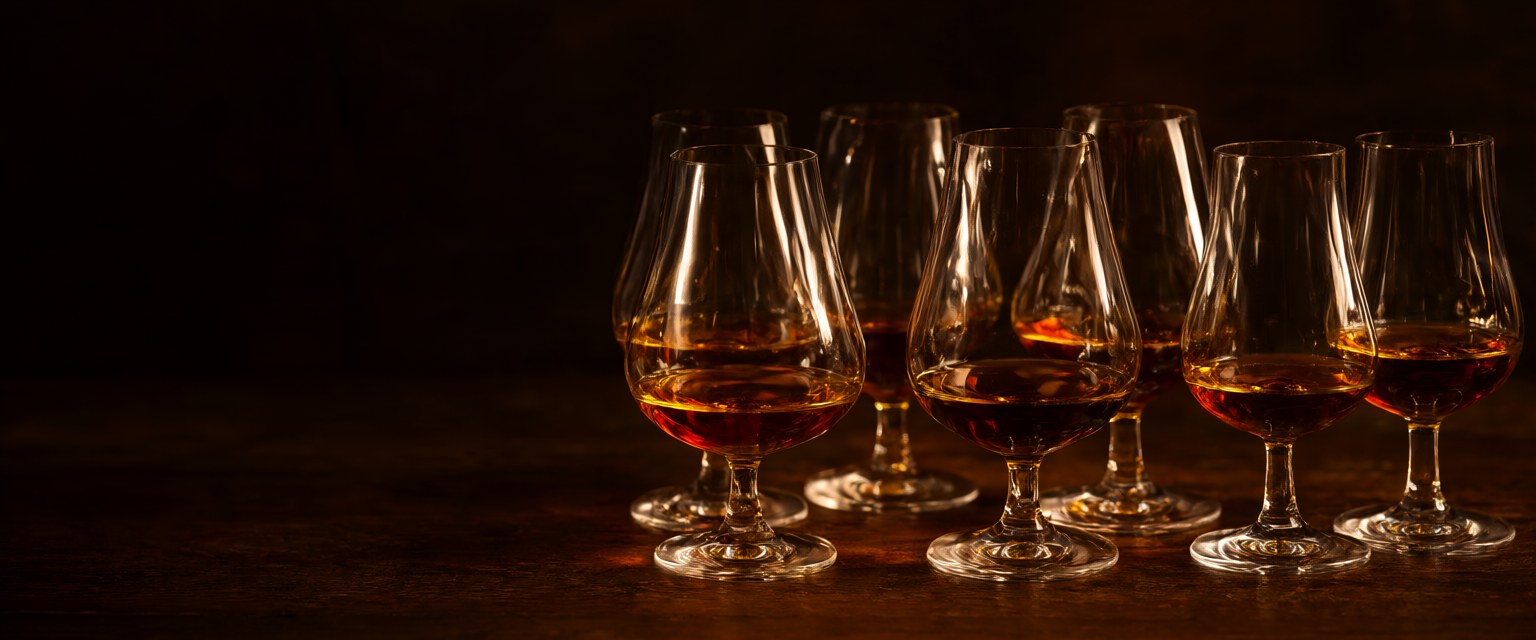
The best glass for cognac is a tulip-shaped tasting glass, which concentrates the aromas and keeps the alcohol from masking the nose. A large, wide balloon glass is certainly classic, but the aromas dissipate quickly in it.
Serve cognac at room temperature, without warming it. Pour a small measure into the glass, let it breathe for a few minutes and enjoy it slowly. A few drops of water help a strong cognac to open up. Younger cognacs can happily be enjoyed on the rocks or in a cocktail.
Cognac and food
Cognac is not only a digestif. A younger, fresher cognac works well as an aperitif and alongside savoury snacks, seafood or hard cheeses. A more mature VSOP or Napoléon is a good companion to duck, game and desserts with nuts. Old XO and Extra cognacs open up best alongside dark chocolate, dried fruit, roasted nuts or a good cigar. Be bold and experiment — there are more good pairings than you might think.
Storage
Unlike wine, cognac does not continue to mature in the bottle. Keep the bottle upright, so that the cork does not come into contact with the spirit, in the dark and at an even temperature. An opened bottle keeps for a long time, but the less cognac there is in the bottle, the faster the aromas begin to fade — a half-empty bottle is best enjoyed within a few months.
Start by comparing
The quickest way to get to know cognac is to taste two or three different bottles side by side: for example a VSOP and an XO from the same house, or cognacs from two different growing areas. Miniatures are ideal for this. Note down what you liked, and your next choice will already be much easier.